

Forex Multiple Time Frame Analysis
Multiple time frame analysis is ane of the first level technical assay tools i should be doing before taking whatever trade. Unfortunately, many traders would similar to make their trading decisions based on a single fourth dimension frame. As a outcome, they spend most of their time analyzing the charts on their specific fourth dimension frame without paying much attention to what is happening in the "Bigger Pic." That approach tin can work at times, only a more sensible arroyo would exist to expect at several fourth dimension frames to notice high-probability trading setups.
For a beginner trader, analyzing multiple time frames could exist overwhelming and even disruptive at times. For case, you may look at a 1-minute chart of the EUR/USD currency pair and see that the pair appears to be in a downtrend market. However, if you switch to a daily chart, you may come across that the currency pair has been in an uptrend marketplace for years. And so which chart is right? Is the EUR/USD pair in an upward trend, or is it in a down trend? That's problematic, especially when the time frames don't always align, and there are different kinds of trends on different time frames. As a issue, some traders avoid multiple time frame analysis due to its conflicting nature and varying results. Therefore, in this commodity, I volition explain how to correctly perform a multiple time frame assay and combine it with any trading strategy.
What is Multiple Time Frame Assay?
Multiple time frame assay is a technique for analyzing different time frames for a single currency pair before entering a trade. This type of analysis is best applied using a top-down arroyo because you get-go with a broader view and so work your mode downwardly until you encounter a time frame in which yous can enter a merchandise. Usually, the higher time frame is used to identify a longer-term tendency, while a lower time frame is used to spot platonic trading opportunities to enter the market place. Thus, if there is a strong trend on a higher time frame, trading in the direction of that trend on the lower fourth dimension frame volition likely produce a higher probability of winning trades.
Choosing Best Fourth dimension Frame Combination
The time frame combination can differ based on your trading style. For example, a scalper would adopt a different set of fourth dimension frames than a swing or a position trader. Therefore, it is important to know how to select the best time frames to analyze. If the time frames are also close, you won't be able to tell the departure, which would be pretty useless. It is recommended to use the following 3 different fourth dimension frame charts that are broad enough to read the market.
- Trend chart (Higher time frame chart) – The trend chart helps you place the longer-term or the major trend and shows the big moving-picture show of the currency pair. For example, on the daily chart, if the EUR/USD is trading above the 200 EMA, that confirms the longer-term trend is an uptrend.
- Entry chart (Chart you lot typically trade) – As the name suggests, the entry nautical chart is the chart you lot practice all your technical analysis and place buy and sell trades. For example, if the currency pair in the Tendency nautical chart moves upwardly, you lot should be looking for buy entries. Conversely, if the currency pair in the Trend nautical chart moves downwards, you should exist looking for sell entries.
- Signal chart (Lower fourth dimension frame chart) – The point nautical chart helps to accurately identify the turning points and pullbacks of the trend and tell you exactly when to enter and get out a trade.
When choosing the three frames, nearly experienced traders suggest that time frames should be at least four times apart (1:iv ratio).
For example, if you lot are analyzing a trend on a 1-hour nautical chart, the xxx-minute chart will not provide anything useful that the 1-hour chart already does. But a 15-minute nautical chart is probable to testify clear cycles and cost movements.
Therefore, per the "1:4 ratio", if you use a higher time frame of ane hour, the lower time frame should be at the maximum, 15 minutes (i.east., 60 min/4). Also, if you use a higher fourth dimension frame of iv hours, the lower time frame should be ane hour.
You can apply the below recommended time frame combinations.
1-minute, 5-minute, and 30-minute
five-minute, thirty-minute, and iv-hour
15-minute, 1-hour, and 4-hour
1-hour, 4-hour, and daily
four-hour, daily, and weekly
daily, weekly, and monthly
Multiple Time Frame Analysis Techniques
Once you've decided your preferred fourth dimension frame, use one of the below two techniques to analyze the fourth dimension frames.
1. Using Trend Assay
This method will simply employ the Trend analysis to enter a trade without using whatever technical indicators.
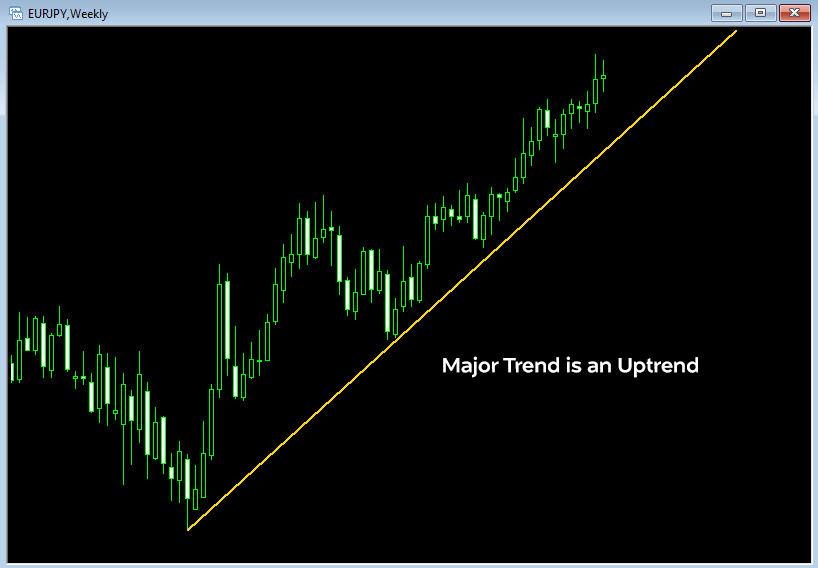
Let'due south look at an instance from the EUR/JPY chart using 4-hour, daily, and weekly charts.
Higher TF: Weekly chart
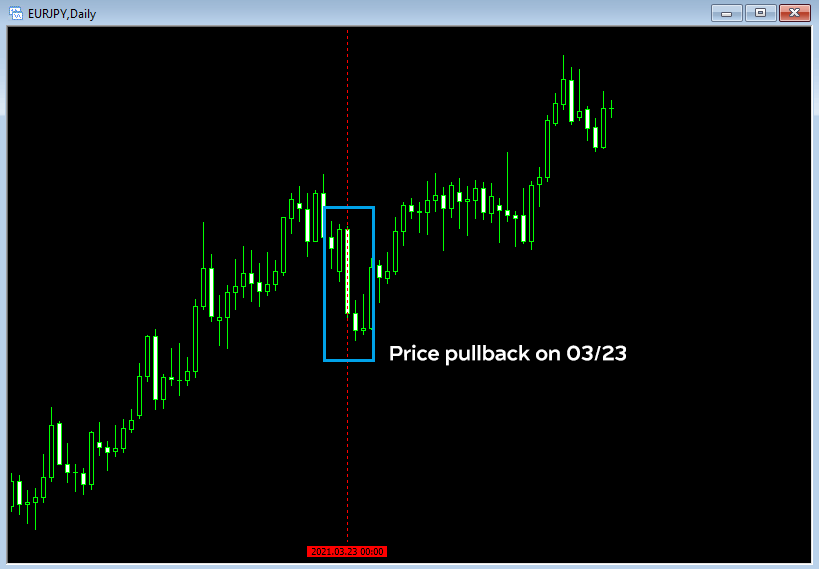
Entry TF: Daily chart
Lower TF: 4-hour chart
First, become to the Trend chart and ostend the major trend, whether it an uptrend or a downtrend.
Then switch to the Entry chart and wait for the toll to pull back in the contrary direction of the major trend identified on the Trend nautical chart. After that, wait for the end of the pullback.
And then, go to the Signal nautical chart and look for a tendency reversal where the price starts to move in the major tendency direction.
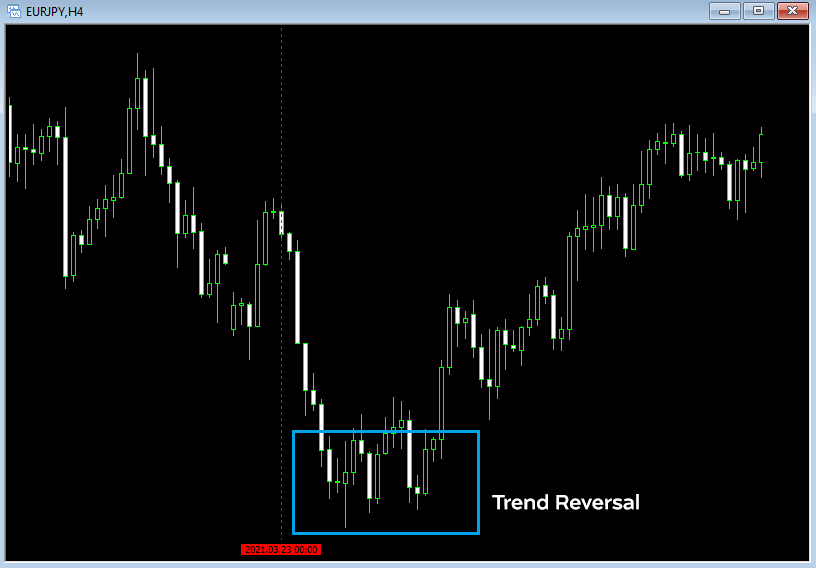
Then switch dorsum to the Entry chart and open a merchandise.
Set the end loss at the previous price pull back on the Entry chart. You can continue the merchandise open until the tendency weakens.
ii. Using Technical Indicators
In this method, you will proceed with the trading determination afterward getting the confirmation from your technical indicators or analysis. Here you can use indicators such as Moving Averages, Stochastic Oscillator, RSI, or Support and Resistance cardinal levels that support your trading strategy.
Let'due south take an instance from the AUD/USD chart using 4-hour, daily, and weekly charts.
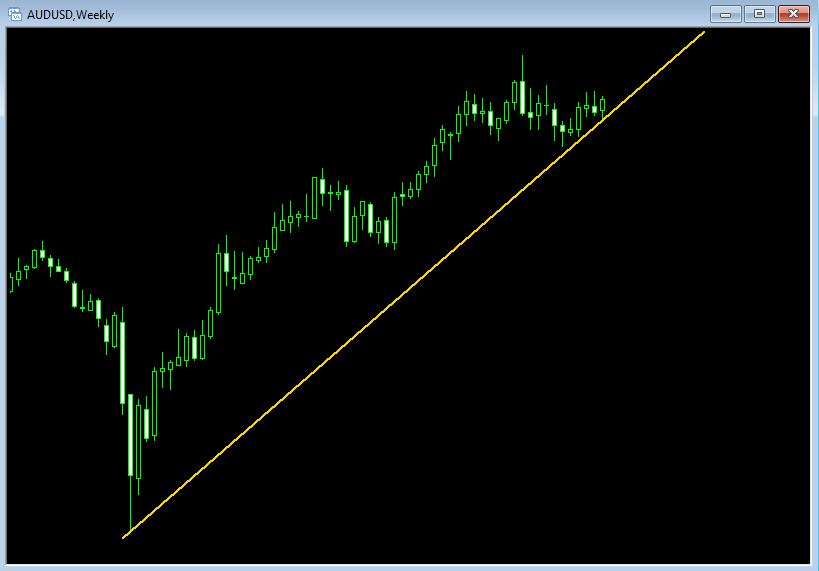
College TF: Weekly chart
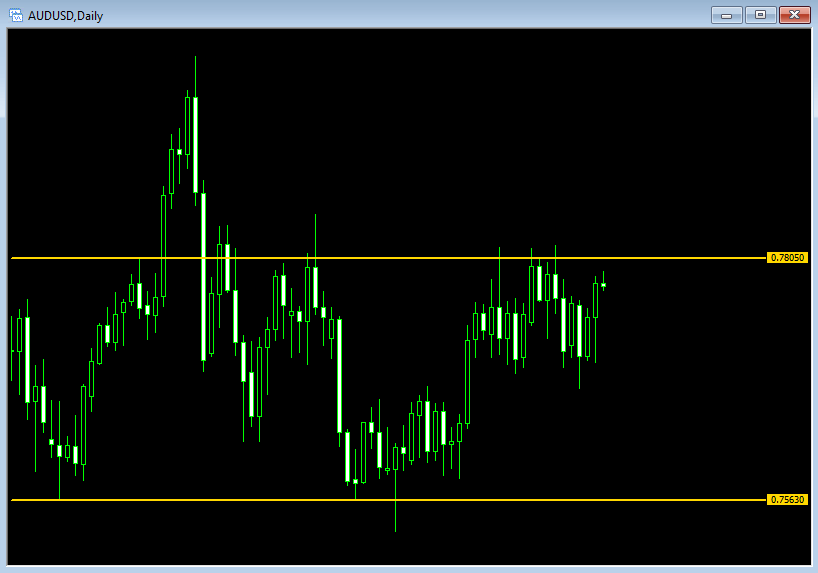
Entry TF: Daily chart
Lower TF: 4-hour chart
Starting time, go to the Tendency chart and confirm the major tendency. Basically, hither you demand to identify whether the overall trend direction is an uptrend or a downtrend. Equally yous tin can conspicuously see on the beneath AUD/USD weekly chart, the currency pair has been trending up for several years.
Then, go to the Entry chart and depict your support and resistance lines. Here you need to analyze the week ahead's potential market direction and place valid trade areas.
Lastly, switch to your Signal nautical chart to place an optimal entry indicate to purchase the AUD/USD in the major trend direction. In this case, I will be using the RSI indicator (with a 14 period) to confirm the buy signal. As you can see on the four-hour AUD/USD chart, the RSI is at the oversold area on 04 May 2021 equally it crossed below the 40 level mark(circled in blue). Also, there is an overlapping resistance zone between the 4-hour chart and the daily chart. This indicates a strong trading zone considering it's nested within a larger time frame zone.
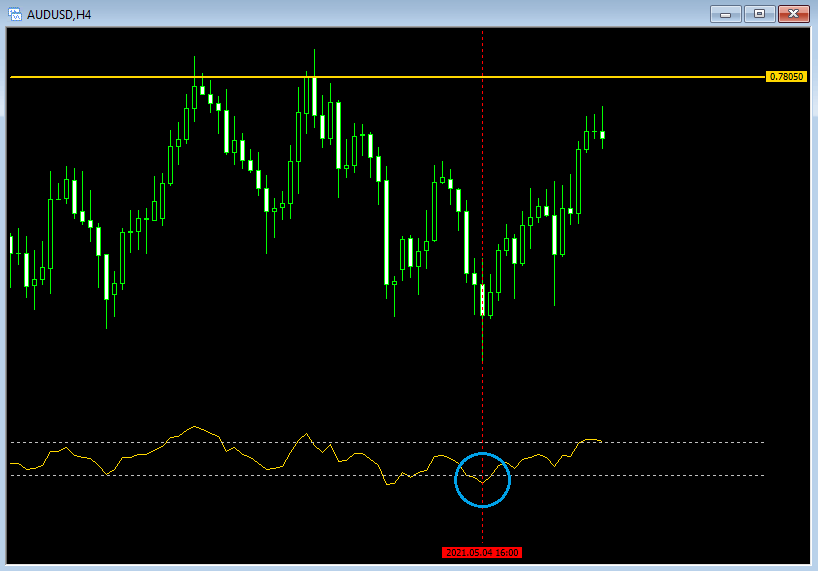
Since the buy point produced on the bespeak chart lined upward well with the Entry and Trend charts, we can identify this buy entry as a high probability winning trading setup.
The Bottom Line
The utilize of multiple time frame analysis can significantly improve the odds of making a successful trade. Unfortunately, many traders ignore the usefulness of this technique and stick to a unmarried fourth dimension frame that they are more comfortable with. Therefore, make information technology a habit to wait at multiple time frames when trading.
If you constitute this article interesting, permit me know past commenting below what you lot think most this trading strategy.

Forex Multiple Time Frame Analysis,
Source: https://www.chinettiforex.com/multiple-time-frame-analysis-in-forex/
Posted by: roushblit1936.blogspot.com
0 Response to "Forex Multiple Time Frame Analysis"
Post a Comment